Splitting Tines: Walker Chen
Written on March 28th, 2026 by D. T. Grimes
In this post, I’m excited to introduce you to Walker Chen, an inspiring member of our modern penmanship community who has demonstrated an outstanding taste for fine penmanship in recent years. Whether he is painstakingly cutting and wielding goose quills, dashing off bold ornamental signatures, precisely identifying musical notes by ear, or conquering the English Roundhand, this young man brings a degree of precision and excellence well beyond his twenty years. The following interview presents an illuminating look into the mind of this rising star in the penmanship world.
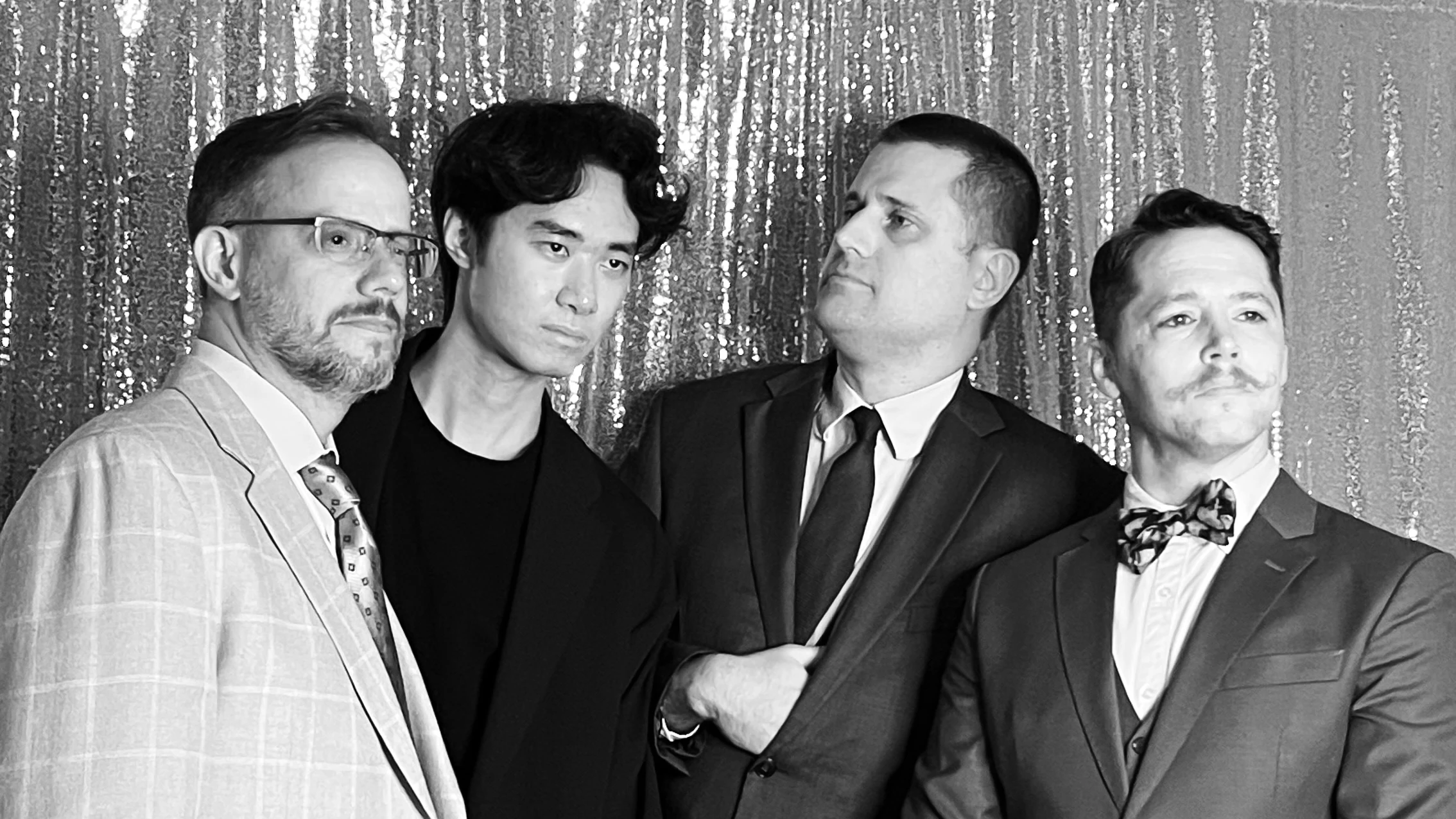
Loria, Chen, Harris, and Ward at the 2025 conference banquet.
Table of Contents
Walker’s backstory
DG: Thanks for taking this interview, Walker! We only met last year, but I’ve watched you online for a while and I’m so impressed by all that you do. I’ve got a feeling we’ve only seen the beginning of the great things you’re going to accomplish. Could you give the readers a background portrait of your penmanship career to this point?
Walker Chen: Thanks for the invitation—it’s an honor to talk with you, David!
Talking about my penmanship journey fills me with a sense of wonder and good fortune. I was born into a Chinese family steeped in artistic and literary traditions, with a father who mastered the art of traditional Chinese calligraphy. My father named me “Molin” as my Chinese given name, which translates to “The Ink Forest.” I feel incredibly lucky to bear such a poetic name as a penman. It was this nurturing environment that led me to begin practicing the art of Chinese calligraphy at the tender age of six or seven. From elementary school through junior high, I grew up surrounded by praise as a prodigy of good handwriting.
“My father named me “Molin” as my Chinese given name, which translates to “The Ink Forest.” I feel incredibly lucky to bear such a poetic name…”
In the seventh grade, I stumbled upon some educational articles about English penmanship on a Chinese search engine, and the fancy names of those scripts instantly sparked my curiosity and desire to explore. Later, when my father noticed my interest in English handwriting, he casually wrote out a sample of the alphabet in the style he had learned from his Chinese teacher back in school. By today’s standards, it was just a casual cursive style with little connection to orthodox English penmanship, but it was enough to ignite my desire to practice these scripts.
Soon after, since the internet was an inseparable part of life for students my age, I quickly discovered a massive online forum for enthusiasts in China. This forum was home to a large community of experts who had dedicated themselves to promoting the art of English penmanship in China from 2010 to 2018, including Ritchie, Henry, Olivia, and Leo, who were all very famous penmen in that community. The work of these pioneers left a profound shock on me back then, and it was through their posts and the forum’s wealth of professional posts that I learned the fundamentals of authentic English penmanship. With my dad’s help, I acquired my first set of oblique holders and several nibs during the 2018 Spring Festival, marking the beginning of my journey into Engrosser’s Script (ES), as well as the whole arena of American penmanship.

Engrosser’s Script, 1/10/2026
This great Chinese forum adheres to a set of standards for newcomers to the community. Members are strongly encouraged to post their practice exercises and build their own personal “progress posts”. However, because of their extremely rigorous professional standards, beginners were also expected to receive many incisive and sometimes harsh critiques, aside from some necessary encouragement. The level of expertise in the forum’s discussions far exceeded my expectations. I was amazed by the meticulous detail with which the experts discussed ES. “It truly is a rigorous and standardized form of calligraphy!”, I thought. Although many people gave up practicing because of this environment, I did not. Thanks to the perseverance I developed through rigorous penmanship practice since childhood, I was determined to explore more styles than merely ES.
In 2018–2019, I started the famous “oval drills” arm-movement exercise and began experimenting with both Business Penmanship (BP) and Ornamental Penmanship (OP) at the same time. Apart from the time surrounding my high school entrance exams in 2020, I have hardly ever stopped practicing. In 2021, I shifted my focus to OP — a style I found profoundly artistic and utterly captivating — along with beginning college in the United States. Over the next year or two, I practiced almost obsessively to develop the muscle memory for arm movement, and made significant progress. In 2022, I attended my first IAMPETH annual conference in Atlanta, which had a profound impact on me and gave me a strong sense of belonging after years of solitary practice.

Business Penmanship, 10/3/2022
Around the same time, I began pursuing more than American penmanship since I had developed decent skills executing all the main forms of American penmanship (except pen-flourishing). It was at this turning point, English Roundhand (ER) and the fascinating history of post-renaissance European penmanship struck a chord for me. By that point, I hadn’t practiced ES systematically for at least two years. After becoming obsessed with arm-movement writing, I had grown weary and impatient with practicing this style, which requires an extremely slow pace and exceptional finger stability. When I took the time to properly study the British “ancestors” of ES, I was completely captivated by their characteristics. Influenced by Ritchie’s vigorous practice of ER, I began to delve into this older “pointed-pen” script.

English Roundhand, 3/9/2026
Over the course of my four years in college, while completing my studies, my interests in penmanship continued to evolve from intensive practice of the English Roundhand script to exploring other skill sets, such as the Italian Hand, the French Bastarde, and the cutting of quill pens. My interest in the history of penmanship reached its peak in 2022. I read extensively on European penmanship, pored over countless historic copybooks archived online, and studied the practice instructions provided by the masters of the time. To this day, I continue to practice eight or so styles on a rotating basis, and I’ve made great progress by shifting my focus between them.
On learning penmanship
DG: It’s been pretty extraordinary to see the rate you progress, particularly in regard to the last several years of explorations in English Roundhand. Can you tell us a bit about the way that you approach learning penmanship?
WC: I don’t consider myself a prodigy when I see what some beginners accomplish in such a short time. That said, I do feel that I’m quick to correct my mistakes. When I first started learning arm-movement writing, for nearly a year, I couldn’t produce a single capital stem that I found tolerable compared to the examples — even though I thought I was doing pretty well. Looking back at all the scripts I’ve practiced, I think my approach is quite different from others. I never spend a lot of time practicing basic elements (such as BP’s oval drills or ES’s shaded downstrokes.) I always want to push forward and produce something that, at a glance, “looks like” the style. Because of this, I believe that when I am learning a new script I’m able to grasp the essence of its style in a relatively short time and produce work that feels authentically in the spirit of the script. This leapfrog approach to practice also has its drawbacks, though. When it comes to the details and subtleties of a script, my initial practice doesn’t hold up to close observation. So, after a period of general practice, my approach shifts to specialized practice, gradually solidifying all the details and subtleties.
“I think my approach is quite different from others. I never spend a lot of time practicing basic elements…”
Another point I’d like to make regarding learning is that I spend more time observing than practicing. In fact, before I acquired my first oblique penholder in 2018, I had already spent nearly half a year immersing myself in posts on the Chinese forum, reading all the technical articles, and reviewing fellow forum members’ practice logs. As a result, I had a fairly thorough understanding of the Engrosser’s Script before I picked up the pen.
On practice methods
DG: One thing I have noticed is that you’re very consistent in the manner and frequency of your practice. In Virginia, I was inspired by the intention you put towards sitting down and actually writing, even with all of the social comings and goings around you. Can you tell us about your approach to practice?
WC: Practice is undoubtedly the only way to master penmanship. I’ve come to realize that no matter how well I understand some hardcore techniques, if I can’t develop muscle memory and write consistently, it’s as if I don’t know them at all. First of all, I believe that practice is something that can happen at any time, provided I have the necessary materials. 99% of what I’ve written since I first picked up the pen has been “practice” on scrap paper rather than anything else.
For me, a typical practice session is spontaneous, never a struggle or a painful process. Of course, it’s undeniable that in the early stages of learning a script, one inevitably goes through some rather boring basic drills. However, once you move past this stage, practice should be enjoyable—and absolutely not mechanical repetition. As many people know, many of my practice sheets (especially for arm-movement scripts) don’t have any guidelines. Practicing directly on a completely blank sheet of paper may have some obvious drawbacks, but I believe the benefits it offers are far more significant and valuable. Without guidelines, you will subconsciously train your eyes to align your writing (even if it’s just a single word) along an invisible line, while also developing a precise sense for slant, spacing, overall presentation, etc. Therefore, if I want to write for a few hours on a random evening, I usually just grab a sheet of paper and start writing. If necessary, I’d quickly sketch out some very rough guidelines.

English Roundhand, 2/27/2026
On the other hand, if I want to focus on overcoming a specific difficulty, I might increase my practice for that particular issue—perhaps spending time measuring exemplars, sketching structural drafts with a pencil, and, of course, doing repetitive exercises. However, I’m not a big supporter of the approach that focuses solely on one problem and grinds away at it for a long time. For example, if I’m having trouble writing a capital D well, I wouldn’t spend two weeks writing only that letter. Instead, while deliberately practicing the D, I’ll integrate all other aspects, such as word practice or other letters in the same family.
“I’m not a big supporter of the approach that focuses solely on one problem and grinds away at it for a long time.”
One final point I’d like to make is that most of the references I use for practice are original manuscripts, and I spend less time observing photo-engraved or plate-engraved prints. From the very first day I started, I’ve done my best to collect all the high-resolution scans of original manuscripts of all kinds of scripts I could find, using them as the best learning materials available. From original manuscripts, you can gain not only a direct visual understanding of what authentic writing looks like, but a wealth of other information—such as the force of strokes, writing speed, ink texture, and nib condition. These details simply cannot be obtained from photo-engraved exemplars. I am a practitioner obsessed with original manuscripts, and I deeply believe that the insights gained from a single page of manuscript can be much richer than reading an entire book of theories. This is why, during the IAMPETH conference, I’m willing to sacrifice plenty of social opportunities to spend as much time as possible in the archive room. I also feel that studying original manuscripts is a method many penmen today underutilize, especially since an enormous number of them are now accessible through online archives and the generous sharing posted by many fellow penmen (such as David!). So, study them diligently and cherish the wealth of resources available to us today!
“I deeply believe that the insights gained from a single page of manuscript can be much richer than reading an entire book of theories.”
On exploration & experimentation
DG: I’m a firm believer that to be a great penman one needs a thirst for knowledge and a desire to refine their methods through exploration and experimentation. Not everything can be learned from a book or a teacher. The best penmen I know all share these qualities, and I see them in you, as well. What do you think about the roles of exploration and experimentation in your practice?
WC: Thank you for asking me this, David. I wholeheartedly agree with your point of view. As I understand it, a great calligrapher is not merely someone who has skills writing with a pen on paper, but an insatiably curious explorer and practitioner. The scope of the practice extends beyond writing itself to encompass every aspect related to it.
A clear example for me was when I discovered that a brief break not only prevents regression but actually helps you identify issues you’ve long overlooked, thereby leading to progress. Over the past two years, I’ve occasionally taken thorough breaks from writing—sometimes lasting a week or two, or even a month. After these breaks, I’ve found my handwriting has actually improved, and I’m able to achieve the desired results with greater ease.
“…a brief break not only prevents regression but actually helps you identify issues you’ve long overlooked…”
I also recommend that anyone serious about penmanship take the initiative to explore the benefits that can be gained from refining their tools. In this regard, Ritchie Wei is undoubtedly a master. Before him, I rarely encountered anyone who independently explored techniques for precision-grinding nibs, perfecting ink recipes, cutting quill pens, treating paper surfaces using Jan Vande Velde’s documented methods, and creating flawless, mirror-like gilded patterns with a self-blended gesso. The information regarding these technical explorations is accessible and easy to understand, but few are willing to invest the time to pursue them. Once you try, you will discover the dramatic transformations these explorations bring to the writing experience. Admittedly, the connection between skill and tools is not absolute, but good tools are indeed essential for achieving a perfect result. Under Ritchie’s influence, I gradually developed my own method of finely grinding nibs to achieve a perfect contrast effect in OP writing, meticulously cutting quill pens that closely resemble the originals using traditional techniques, and formulating black and white inks with ultra-high contrast. These explorations are the hallmarks of a great practitioner, for penmanship is not an art that can be perfected casually.

Cancellaresca Corsiva, 4/27/2025
On my path to mastering penmanship, self-study has accounted for the vast majority of the journey. My mentors have offered me much constructive and decisive advice, but the insights gained through self-exploration may be even more valuable than simply adopting others’ techniques. However, I certainly recommend that if your own judgment tells you that your writing is far from the examples, then seeking guidance from an experienced master will be extremely beneficial—perhaps even essential. In areas where I lack the natural talent or confidence to reach the highest levels, I would unquestionably seek valuable advice from the most accomplished penmen I could find.
On mental health
DG: When I was your age, I really wrestled with the way that penmanship was bringing out my maladaptive perfectionism. I think the need to be constantly improving paired with the magnifying glass that gets placed on up-and-comers can have some negative effects on their happiness and satisfaction with the art. How do you protect your mental health when it comes to studying penmanship?
WC: It’s a really good point that you’ve brought up, David. The fear of perfectionism definitely comes up from time to time, but I’ve managed never to let it dominate my passion. I remember a really hard time back in 2021, when I totally lost confidence in my practice. I was getting frustrated with my Ornamental Penmanship, which did not seem to improve for a long time. Once I started feeling that frustration, all the issues that I’d tried to ignore came flooding back, making me feel like there was nothing right about my practice. I was really fighting with the lowercase letters, as I was not even remotely close to the exemplars. The letters wouldn’t align with the baseline, the sentences didn’t have the “flow”, and my upper loops (something I consider the pinnacle of difficulty in this type of script) were suffering.
Breaking through this bottleneck is often a process that involves a long wait preceding an instant breakthrough. For the first time, I set aside my conviction in self-study and signed up for one of Ritchie’s advanced courses. His explanations of key techniques suddenly showed me exactly how to break through. Since then, I’ve learned to strike a balance between a sense of accomplishment and frustration, and I take joy in any sign of progress. This is the most important point: to avoid the fear of perfectionism, one must learn to appreciate one’s achievements based on the standard of “the best one can achieve.”

Spencerian Script, 2/18/2026
Another example of this “pursuit” of perfection is, of course, the process of practicing the English Roundhand. At the very first stage of learning this script, I disappointingly realized I could find almost no original manuscripts from the 18th century online. My learning relied almost entirely on beautifully copperplate-engraved prints, which don’t necessarily suggest authentic natural writing. Under these circumstances, I felt an incredible gap between my own writing and the models, and I still seriously doubt whether it’s even possible for a human hand to produce such work. However, I do not aspire to write as perfectly as the models; rather, I aim to do my best within my capabilities, because at least I can capture its essence and bring it to life on the page.
It would be wrong to say I am free from the burden of perfectionism. Whether comparing myself to Louis Madarasz, Willis Baird, or Joseph Champion, I feel an endless sense of my own insignificance. But whenever I feel frustrated, I try to stop practicing, do something else, eat some deliciousness, and then return to my own journey of growth.
“But whenever I feel frustrated, I try to stop practicing, do something else, eat some deliciousness, and then return to my own journey of growth.”
On Chinese & American penmen
DG: For years now, the Chinese and American penmen communities have operated in a state of competitive symbiosis. Not everyone considers penmanship competitive, but I’ve gained a lot of satisfaction out of competing with my friends and knowing that the Chinese community was full of so many hard-working penmen.
WC: I’m glad that you said that the Chinese community is in a competitive role with the American one and that’s the best thing that could happen. Whether it’s helping my Chinese friends understand the flourishing state of penmanship abroad, or helping the international community appreciate the dedication of Chinese enthusiasts, it’s something to celebrate—because it represents a valuable mutual recognition between the inheritors of local culture and the promoters of foreign culture.
It must be said that English-oriented penmanship in China represents a rather niche cultural group. This is precisely because China is a vast nation with a millennia-old cultural history, penmanship or calligraphy, in the eyes of many Chinese people, refers exclusively to the culture of artistically writing Chinese characters with a brush. However, as a penman who “goes against the grain,” I deeply feel that both cultures are profound and vast, and both are sophisticated art forms worthy of recognition.
As someone who has spent five years in the U.S. and has gained “some recognition” within the Chinese community, I feel that at times I help bridge the gap between these two worlds. Since I’ve been very active in Mike Ward’s Discord group—which I joined after the 2022 Atlanta Annual Conference—I frequently share resources and information between the two worlds. While inspiring many people, I also take pride in being able to bring a fresh perspective to both sides.

Ornamental Penmanship, 8/9/2020
What follows is a highly controversial topic, but I dare to speak it out. Due to the influence of traditional Chinese culture, Chinese penmen place great importance on the Chinese term “copying from originals” (临帖). In my view, it is precisely this deep-rooted pursuit of “orthodoxy” that drives Chinese penmen to study classical models with such meticulous precision. Take pointed styles as an example: many “modern” styles are not well-received within the Chinese community; in extreme cases, they are even viewed as a sign of lost aesthetic sensibility. There is a reason for this: because of the emphasis on “copying from originals,” penmen’s aesthetic sensibilities become dominated by classical styles, leading to a psychological aversion to modern or unconventional styles. Of course, I’m not suggesting that calligraphers in the U.S. or elsewhere give up practicing this way; rather, the Chinese community demonstrates a strict, almost obsessive dedication to adhering to classical standards. This is probably why many penmen in China are in leading roles in terms of faithful imitation. The question of how far imitation should go, or whether such practice is worth advocating, is another matter entirely.
“Chinese penmen place great importance on the Chinese term “copying from originals” (临帖). In my view, it is precisely this deep-rooted pursuit of “orthodoxy” that drives Chinese penmen to study classical models with such meticulous precision.”
Online, there are some differences between the global community and the Chinese community. Frankly, due to the design of social media platforms, the Chinese community functions more like a casual chat place where people are able to share and critique each other’s work. However, I’ve noticed that when someone posts a piece hoping to receive constructive criticism, the community becomes exceptionally meticulous. In the U.S., the group chats I’ve participated in present similar characteristics; however, people often lack substantive critical engagement, with facile encouragement predominating. To be honest, I believe a professional online platform should encourage more competition and commentary; otherwise, it feels like just sharing an “Instagram Story” in a different setting. Of course, people often post work not intending to seek feedback—and sometimes even actively dislike it. I’ve personally struggled with this balancing act, so most of the time, I just opt for something quick and easy, like leaving a like.
In short, I really hope for a platform where the vibe strikes a balance between praise and criticism. To me, this has always been the biggest challenge in online interaction. Unlike face-to-face communication, misunderstandings and arguments can easily arise online due to the ambiguity of emotional expression.
On becoming a teacher
DG: You recently announced that you are preparing to take on students in the discipline of English Roundhand. From experience, I know that taking on the responsibility of becoming a teacher is a really big part of developing as a penman, so I am excited to see you taking that step! What excites you most about teaching?
WC: Years of practice have enabled me to offer fairly well-informed advice on many scripts, but much of my expertise and approach has been shaped gradually over time through experience and habit. The way I’ve learned certain things may not be applicable and may be difficult to replicate, because everyone has their own way of improving. We have to keep in mind that the instructions provided in all old textbooks have been proven through experimentation; without a broad audience, I don’t think I can truly know whether my own methods are effective. This was also the aspect that made me most hesitant before deciding to teach. Of course, I very much hope to share my insights, experience, and techniques with everyone who needs them, and that excitement has encouraged me to take this step.
I thoroughly enjoy the process of designing my course syllabus; it makes me feel like an ancient writing teacher publishing copybooks. I’ve done my best to make it thorough, systematic, and progressively structured. I did consider simply copying the teaching methods from existing master-level publications, but I ultimately decided that arranging the material in the way I believe is most effective—following my own instincts—is the right approach.
“I ultimately decided that arranging the material in the way I believe is most effective—following my own instincts—is the right approach.”
I’m not one for rigid teaching methods. In my lessons, I aim to go beyond standard, basic explanations to include personalized, strategic advice. I don’t have many concerns about students of various skill levels and backgrounds. It’s really a case-by-case process: for students with a weak foundation, steadily breaking down and mastering the basic strokes one by one is the most essential and efficient way to progress; if I’m working with an experienced student, my approach will focus on refining their details—elevating work from an 8 to a 10. As I’ve emphasized in my course description, no short-term course can guarantee a dramatic leap in skill. I want everyone who hopes to learn from me to understand that you should always compare yourself, primarily, to your own past performance.

Ornamental Penmanship, 6/11/2025
On critique
DG: A huge part of teaching is the trust that is built between a student and teacher. Navigating the complicated process of developing the student’s hand is a delicate balancing act of encouragement and criticism. Can you tell us about your perspective on giving and receiving feedback on your work?
WC: That is indeed the case. During my early years, I received countless criticisms. Looking back now, only a few were arrogant or biased attacks, while most were invaluable pieces of advice that truly elevated me. I was only 13 when I first started Engrosser’s Script. At the time, I was incredibly headstrong and spoke very bluntly. This drew criticism from many of my seniors. In fact, most beginners have a very unclear understanding of their own skill level—just like me, always thinking they’ve already done well enough at a certain stage.
However, criticism is something anyone who truly wants to improve must endure. My view is simple: if your writing is good, it is good and deserves praise; if it is mediocre, don’t blame others for criticizing you by directly pointing out areas where you can improve. The only thing we need to prevent is impoliteness in communication. Many people have a strong ego and feel intense anger when questioned by those they perceive as less skilled. Whenever I encountered such situations in my youth, I would—after sulking for a while—carefully examine whether what they said was actually spot on and objective. More often than not, the advice from my seniors pointed to aspects I had never noticed and had assumed were already perfect. In such cases, what reason did I have to feel uncomfortable?
Whenever I seek criticism, I explicitly ask for blunt, constructive guidance. When I’ve been in a position to offer advice myself, I’ve sometimes found that people aren’t actually open to criticism. In those situations, I will stop my advising, which only represents my own perspective, as it might cause unnecessary disputes. At the end of the day, everyone has their own sense of aesthetics and knows what they want to pursue. If that doesn’t align with my own goals, the only thing I can do is encourage them not to give up easily.
When asking questions, I believe we should think things through and do our own research before asking. When you expect feedback, you should first provide a clear image and specify exactly which technical aspect you’re asking about. Ideally, most questions should include a reference example for context.
When asking for critiques, I always hope to receive analyses of both the big picture and the details, along with clear guidance on what to do next. I constantly see people offering brief, critical remarks without elaborating further or explaining what their suggestions can accomplish. If we’re offering advice, why not provide something practical and actionable?
On setting a good example
DG: In our community, the old penmen of yesteryear are often glorified as personal heroes and inspirations, so I think that all penmen who hope to contribute to the legacy of this art have a duty to think about how their lives may inspire others. I certainly know that you have inspired me in a lot of ways in just the last few years. If you could offer words of encouragement to a young penman who looked up to you, what would you say?
WC: I’m grateful that my way of learning the art, or the way of my life, inspired you, David.
To all beginners who are drawn to this art of penmanship, I would like to say: make the process of learning this art an opportunity to embrace something new in your life. As many classic writing manuals point out, everyone has the potential to master beautiful penmanship; the masters simply began their journey a little earlier and have accumulated more experience than you. It’s that simple.

Italian Hand, 10/4/2025
I would also like to add: don’t ask, “How can I become like that master?” Ask instead, “What do I actually stand for as a penman?” Do you care about the accuracy of form, even when no one else notices? Do you have the patience to deliberately and intelligently practice the same stroke? Are you willing to develop your own judgment, instead of relying on praise?
If the answer is yes, then you are already on the right path.
If anything I’ve done has inspired you, then take that as a starting point—not a destination. Push further. See more.
What’s next for Walker Chen?
DG: On a personal note, what are your plans for the future? You’re in school right now, but have you considered pursuing professional penmanship beyond your upcoming English Roundhand course? Have you considered what kind of work you’d like to put out into the world or what ideas you’d like to research (and maybe publish?)
WC: At the end of last year, I had already graduated from college. Yay! I have to say, I’m not sure yet whether I’ll make penmanship my main career. For various reasons, I currently plan to offer online lessons as a first step. However, one thing is absolutely certain: penmanship will definitely remain a lifelong pursuit for me.
My journey in penmanship won’t follow a predetermined path, but it will progress steadily. Without a doubt, I plan to produce more work rather than focus solely on practice. I will continue to study various styles of penmanship and broaden my knowledge through historical research. I also hope that one day I will uncover the secrets behind the marvels and mysteries left by those old masters.

Ornamental Signature, 3/29/2025
In addition, I hope to use my research and practical findings to correct and shed light on the many misconceptions that have arisen from outdated collective assumptions. I will endeavor to identify areas where our collective understanding is vague or inconsistent, and work through them carefully enough that they can be explained with some degree of precision. This includes looking closely at primary sources, comparing different hands and periods, and, just as importantly, testing those observations through actual writing rather than theory alone.
There are many areas in the penmanship field—historical, technical, and even pedagogical. I’m interested in studying those more seriously, and, if I reach a level where I feel confident in my understanding, possibly writing or publishing something that helps bring more precision to those discussions. As for output, I would rather produce less, but with clarity and intention, than simply produce more.
Thanks for reading!
DG to reader: Thank you for taking the time to read this interview! I hope that you found some of Walker’s insight valuable in your own pursuit of fine writing and that the topics we covered were interesting and encouraging to you in some way. This article is the first of my revived “Splitting Tines” series of interviews that will focus on bringing forward and highlighting excellence in the penmanship community. Keep up to date on future articles, goings-on here in the studio, and more by joining the Masgrimes Newsletter.
To see more of Mr. Chen’s work, you can give him a follow on Instagram (@penmanwalker) and consider contacting him for Private Lessons in English Roundhand.
Walker Chen: walker1665chen@gmail.com
